
A burst supply line can push hundreds of gallons across a Houston slab before you find the shutoff. The water you can see is the easy part. The hidden moisture in drywall, baseboards, and concrete causes the expensive damage, and Gulf Coast humidity slows natural drying. A qualified water damage company shortens that window with extraction, structural drying, and moisture readings that prove the house is dry. Speed and measurement decide whether you replace a few feet of drywall or an entire kitchen.
At Bob’s Water Damage Restoration, we answer these calls around the clock across Houston, Pasadena, Pearland, Sugar Land, and League City. This article covers how professional mitigation works, what the industry standards say, what it costs, and how to vet a contractor before you sign anything.
Keys
- Dry wet materials within 24 to 48 hours. EPA guidance links this window to preventing most mold growth, and Houston humidity leaves little margin.
- The water category, not the size of the puddle, sets the scope. A clean supply-line leak and a sewage backup in the same room need very different removal and cleaning protocols.
- Demand moisture readings before repairs start. Concrete slabs and wall cavities can stay wet for days after surfaces feel dry, and flooring installed too early fails.
How Water Damage Restoration Dallas TX Protects Your Home
What a Water Damage Company Actually Does
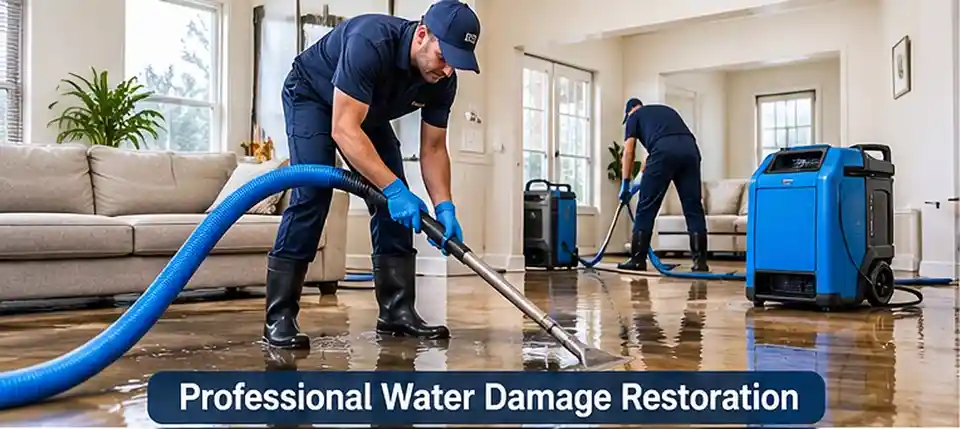
A water damage company stops active damage, removes water, dries the structure, and documents every step. Restoration (the full process from extraction to rebuild) is different from mitigation (the emergency work that stops damage from spreading). Most homeowners need both, in that order.
| Service | What It Means | When You Need It |
|---|---|---|
| Emergency water removal | Pumping and extracting standing water | Water is on the floor right now |
| Water extraction | Pulling soaked-in water from carpet, pad, and hard floors | Carpet squishes underfoot |
| Structural drying | Air movers and dehumidifiers dry framing, walls, and slabs | Water reached walls or subfloor |
| Flood damage restoration | Removing contaminated materials after rising water | Storm surge or bayou flooding entered the home |
| Sewage cleanup | Protective removal and sanitizing of contaminated water | Toilet, drain, or sewer line backed up |
| Mold remediation | Containment and removal of mold growth | Musty odors or visible growth after a leak |
| Water damage repair | Rebuilding drywall, trim, flooring, and cabinets | Materials could not be saved |
The order matters. Repairs done over wet materials fail. Removal, drying, and verification always come first.
Why Texas Homes Face Higher Water Damage Risk
Gulf Coast conditions make every water loss harder to dry. Humidity, slab foundations, tropical storms, and occasional hard freezes combine in ways that homes in drier climates rarely face.
| Texas Risk Factor | How It Affects Your Home | What We See in the Field |
|---|---|---|
| High humidity (Houston often averages 70%+ relative humidity) | Wet materials release moisture slowly | Drying takes longer without dehumidifiers |
| Slab-on-grade foundations | Concrete absorbs water and holds it | Flooring cups or delaminates when laid too soon |
| Tropical storms and hurricanes | Wind-driven rain and rising water | Roof leaks, window leaks, and floodwater intrusion |
| Hard freezes (Winter Storm Uri, Feb. 2021) | Pipes in attics and exterior walls split | Attic line bursts soaking ceilings and insulation |
| Flat terrain and clay soil | Poor drainage near foundations | Water pooling at exterior walls after heavy rain |
On recent emergency calls in Houston and Sugar Land, our crews found wet drywall wicking more than a foot above the visible waterline. Our field technicians frequently see this in local slab-foundation homes: the carpet dries, but the concrete beneath stays wet for days. That trapped moisture is what ruins new flooring.
If you have spent a stormy season in Texas, a local water damage company with dehumidification capacity makes complete sense. Fans alone just move humid air around the room.

What Happens Hour by Hour
Water damage gets worse on a predictable timeline. Here is what our crews typically see after an untreated leak.
| Time After Leak | What Happens |
|---|---|
| 0 to 1 hour | Water spreads under baseboards into neighboring rooms |
| 1 to 24 hours | Drywall swells, furniture legs stain carpet, odors begin |
| 24 to 48 hours | Conditions for mold growth develop on wet organic materials |
| 48 to 72 hours | Clean water can degrade in contamination level; cabinets delaminate |
| 1 week+ | Wood framing warps, flooring buckles, mold spreads in wall cavities |
Your next step is simple: learn the emergency steps below before you need them.
Emergency Steps Before the Crew Arrives
Your actions in the first hour limit the damage. Follow these steps in order while the water damage company is on the way.
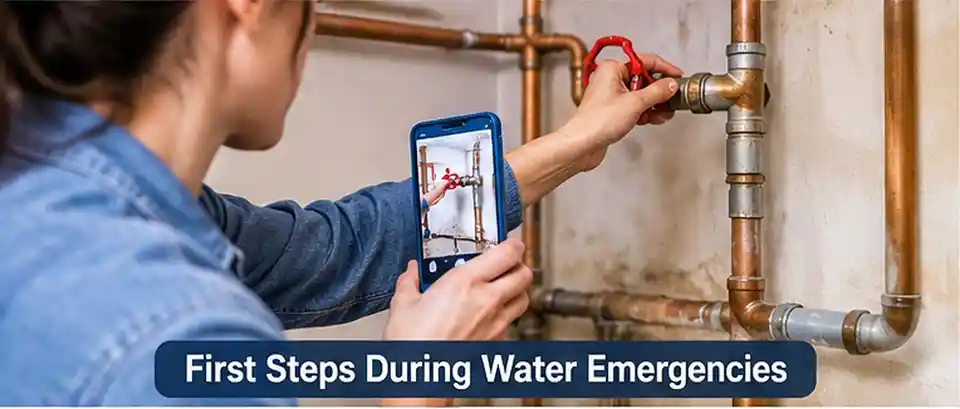
- Shut off the water. Close the fixture valve or the main shutoff, usually near the street or in the garage.
- Cut power to wet areas. Flip the breaker only if you can reach the panel without standing in water.
- Avoid contaminated water. Stay out of sewage or floodwater without gloves and boots.
- Photograph everything. Capture the source, the waterline, and damaged belongings for insurance documentation.
- Move valuables up. Lift electronics, documents, and rugs off wet floors.
- Place foil under furniture legs. This prevents rust and stain transfer into carpet.
- Call your insurer. Report the loss early and note your claim number.
- Leave the ceiling alone. Sagging drywall can collapse. Do not poke it.
Our page on what to do in the first hour of emergency water removal walks through each step in more detail. Do not run the HVAC system if you suspect contaminated water or mold. It can spread spores and odors through the house.
Mistakes we see on emergency calls:
- Running box fans in a closed room with no dehumidification
- Using a household vacuum on standing water
- Tearing out drywall before photos are taken
- Waiting until Monday on a Friday-night leak
Save our number, (855) 231-6948, in your phone before storm season starts.
IICRC S500 Water Categories Explained
The IICRC S500 (the Standard and Reference Guide for Professional Water Damage Restoration) sets the industry rules for categorizing water and drying structures. It is published by the Institute of Inspection, Cleaning and Restoration Certification. Insurance adjusters use it to judge whether an estimate is reasonable.
The water category describes contamination level. It controls what can be dried in place and what must be removed.
| Category | Description | Common Houston Sources | Typical Cleanup Action |
|---|---|---|---|
| Category 1: Clean water | Sanitary source, low health risk | Burst supply line, ice maker line, water heater supply | Extract and dry most materials in place |
| Category 2: Gray water | Significant contamination | Washing machine overflow, dishwasher discharge, toilet overflow without feces | Antimicrobial treatment; remove carpet pad and saturated insulation |
| Category 3: Black water | Pathogens or harmful agents | Sewage backup, bayou flooding, storm surge, ground runoff | Containment, PPE, removal of porous materials, sanitizing hard surfaces |
Categories can worsen over time. Clean water sitting in warm, humid conditions picks up bacteria from carpet, pad, and building materials. A Friday leak left until Monday can turn a simple dry-out into a contaminated-water job. This is why same-day response saves money.
Water Damage Restoration Houston TX: Beat the 48-Hour Clock
IICRC Water Damage Classes
The water class describes how much water was absorbed and how hard the space will be to dry. It drives equipment counts and drying days.
| Class | Absorption Level | Example | Typical Drying Time |
|---|---|---|---|
| Class 1 | Least absorption; part of a room | Small leak on tile or sealed concrete | 1 to 3 days |
| Class 2 | Significant; whole room, carpet and pad wet | Washing machine overflow in a laundry room | 3 to 5 days |
| Class 3 | Greatest; water from above, walls saturated | Attic pipe burst soaking ceiling and walls | 5 to 7 days |
| Class 4 | Specialty drying; dense materials | Wet hardwood, plaster, brick, or deep slab saturation | 7 to 14+ days |
Burst Pipes: The Most Common Class 3 Call
Pipe bursts often produce Class 3 losses because water comes from above. Attic supply lines in Pearland and League City homes soak insulation, ceiling drywall, and walls on the way down. A split PEX fitting can release several gallons per minute.
When a line splits, our steps for burst pipe cleanup and water shutoff start with stopping the flow and checking the ceiling for sag. Wet blown-in insulation usually has to be removed because it compacts and holds moisture against the drywall.
Find your main shutoff today and make sure everyone in the house knows where it is.
Drying Times by Material Type
Materials dry at very different rates. Dense materials hold water longer, and Houston humidity stretches every timeline. These ranges assume professional equipment and a controlled environment.
| Material | Absorbency | Typical Professional Drying Time | Salvageable? |
|---|---|---|---|
| Drywall (Cat 1 water) | High | 2 to 4 days | Often, if dried quickly |
| Carpet | High | 1 to 3 days | Often, with Cat 1 water |
| Carpet pad | Very high | Usually replaced if Cat 2 or 3 | Rarely with contaminated water |
| Wood framing (studs) | Moderate | 3 to 7 days | Yes, in most clean-water losses |
| Hardwood flooring | Moderate to low | 7 to 14+ days | Sometimes; may cup |
| Engineered wood / laminate | Low surface, high core | Often swells permanently | Frequently replaced |
| Concrete slab | Low permeance, high mass | 5 to 14+ days depending on depth | Yes; must reach dry standard before flooring |
| Fiberglass insulation | High | Usually replaced when saturated | Rarely |
| Particleboard cabinets | Very high | Swells within hours | Often replaced |
Surface-dry is not the same as dry. A slab can feel dry to your hand while readings show it is still too wet for new flooring.
Drying Equipment Metrics
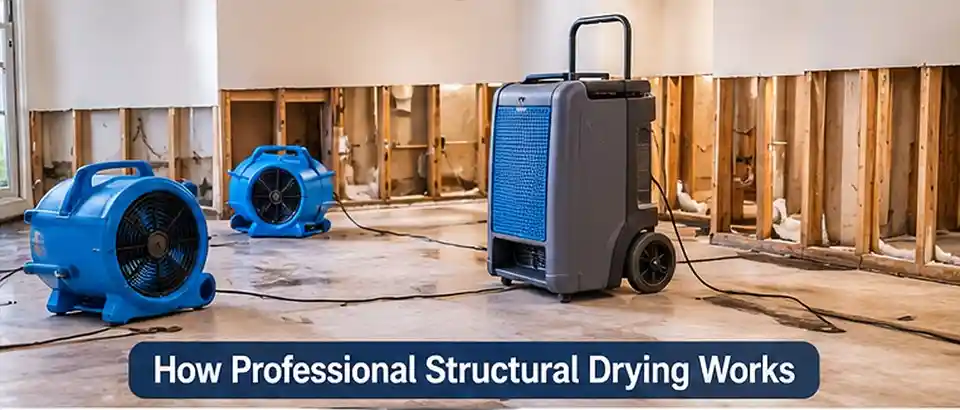
A competent water damage company proves dryness with numbers, not guesses. Here is what typical equipment does and how crews size it.
| Equipment | Job | Typical Performance / Placement |
|---|---|---|
| Truck-mount or portable extractor | Removes standing and soaked-in water | Removes far more water than any household vacuum |
| Air mover | Speeds evaporation from wet surfaces | Roughly 1 per 10 to 16 linear feet of wet wall |
| LGR dehumidifier (low grain refrigerant) | Pulls moisture out of humid air | Large units remove 100+ pints per day under test conditions |
| Desiccant dehumidifier | Dries in cool or dense-material jobs | Used on hardwood, slabs, and Class 4 losses |
| Pin and pinless moisture meters | Measure moisture inside materials | Daily readings compared to a dry reference point |
| Thermal imaging camera | Spots temperature differences from evaporation | Finds wet areas behind walls; confirmed with meters |
| Hygrometer | Measures temperature and relative humidity | Tracks whether the drying environment is working |
Our certified structural drying steps follow this process: map the wet area, place equipment, record daily readings, and adjust until materials hit the dry standard. Drying logs also support your insurance claim.
Ask any contractor for a copy of the daily moisture log before you approve repairs.
Moisture Inspection Checklist
Hidden moisture causes most callbacks. Use this checklist after any leak, even a small one.
Inside the home:
- Baseboards swelling, separating, or showing stains
- Drywall soft at the bottom edge or bubbling paint
- Ceiling stains, sagging, or brown rings below bathrooms or the attic
- Flooring cupping, buckling, or lifting tiles
- Cabinet bases under sinks swelling or smelling musty
- Musty odor in closets or behind furniture
- Higher-than-normal water bill with no change in use
Outside and attic:
- Water stains on attic decking or wet insulation
- AC drain line clogged or drip pan full
- Ground sloping toward the foundation
- Gutters overflowing or downspouts dumping at the slab edge
- Cracked caulk around windows on storm-facing walls
Check your AC drip pan monthly during Houston summers. Clogged condensate lines are among the most common slow leaks we find in attics.
If two or more boxes are checked, schedule a professional moisture inspection this week.
Water Damage Restoration McKinney TX: Protect Your Home
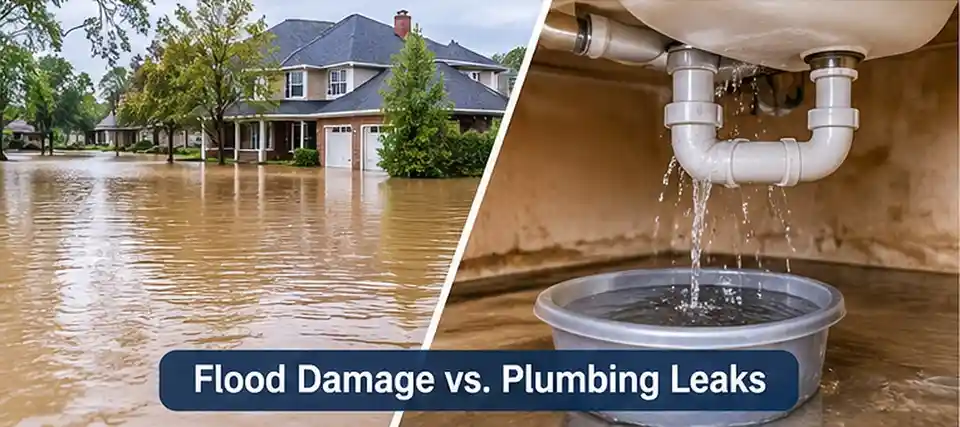
Flood Damage vs. Plumbing Leaks
Floodwater and plumbing leaks are different problems. Rising floodwater from storms or bayous is Category 3 by definition. A burst supply line usually starts as Category 1. Insurance also treats them very differently.
| Factor | Plumbing Leak | Flood (Rising Water) |
|---|---|---|
| Water category | Usually Category 1 at first | Category 3 |
| Drywall removal | Often dried in place if fast | Typically cut above the waterline |
| Insulation | Removed if saturated | Removed |
| Standard homeowners policy | Often covers sudden, accidental leaks | Usually excludes flood |
| Coverage needed | Homeowners policy | Separate flood policy (NFIP or private) |
| NFIP waiting period | Not applicable | Typically 30 days after purchase |
Harris, Fort Bend, Brazoria, and Galveston counties have flooded repeatedly. Hurricane Harvey in 2017 dropped extreme rainfall across the region, and many affected homes sat outside mapped high-risk flood zones. A lower-risk flood zone label does not mean your home will not flood.
For storm and bayou water, our flood damage restoration and cleanup process covers contaminated material removal, sanitizing, and drying. Flood cuts (removing drywall a set height above the waterline) let crews dry wall cavities and remove contaminated insulation.
Check your declarations page today to confirm whether you carry flood coverage.
Mold Risk After Water Damage
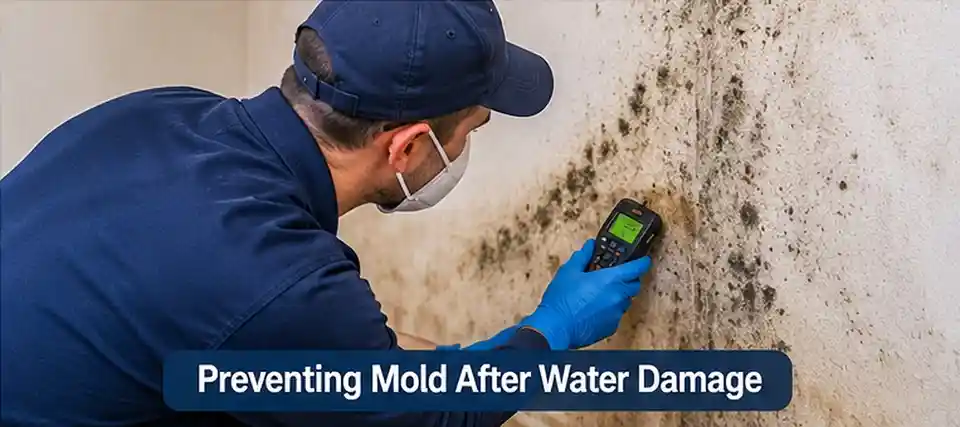
Mold control is moisture control. According to the EPA’s guide to mold, moisture, and your home, drying water-damaged areas and items within 24 to 48 hours prevents mold growth in most cases. The EPA also recommends keeping indoor humidity below 60%, ideally between 30% and 50%.
Houston outdoor air regularly exceeds that range. That makes air conditioning and dehumidification essential after any leak.
| Mold Situation | Who Should Handle It |
|---|---|
| Under about 10 sq ft, clean-water source, no health concerns | Homeowner cleanup is often reasonable per EPA guidance |
| 10 sq ft or more, or extensive water damage | Experienced professional |
| Sewage or floodwater source | Professional with contaminated-water experience |
| Suspected HVAC contamination | Professional; do not run the system |
| 25+ contiguous sq ft in Texas | Licensed mold remediation contractor under Texas Department of Licensing and Regulation (TDLR) rules |
Texas regulates larger mold jobs. TDLR generally requires licensed mold assessors and remediators for projects of 25 contiguous square feet or more. Ask to see the license number before work begins.
Signs of hidden mold:
- Persistent musty odor with no visible source
- Peeling paint or wallpaper on exterior walls
- Stains returning after cleaning
- Allergy symptoms that ease when you leave the house
Our mold remediation services start with the moisture source, because cleaning mold without fixing the water problem guarantees it returns. The EPA notes that dead mold can still trigger allergic reactions, so removal matters more than spraying bleach.
Run a $15 hygrometer in your most humid room this week and note the reading.
Mitigation Cost Breakdown
Every water damage company prices jobs by category, class, square footage, and equipment days. These are approximate 2026 industry ranges for the Houston area. Final pricing always depends on an on-site inspection.
| Service | Typical Price Range | What Drives Cost |
|---|---|---|
| Emergency service call (after hours) | $100 to $350 | Time of day, holidays |
| Water extraction (Cat 1) | $1 to $3 per sq ft | Carpet vs. hard floor, volume |
| Structural drying, Cat 1 | $3 to $5 per sq ft | Class, humidity, materials |
| Gray water cleanup (Cat 2) | $4 to $7 per sq ft | Antimicrobial treatment, pad removal |
| Black water / sewage (Cat 3) | $7 to $12+ per sq ft | Containment, PPE, demolition |
| Air mover rental | $25 to $40 per unit per day | Number of units, days |
| LGR dehumidifier | $70 to $150 per unit per day | Unit size, days |
| Mold remediation | $1,500 to $6,000+ | Square footage, containment, access |
| Drywall repair after drying | $2 to $4 per sq ft | Texture, paint matching |
| Small Cat 1 loss, total | $1,200 to $4,000 | One room, fast response |
| Whole-floor flood, total | $15,000 to $60,000+ | Rebuild scope, contents |
Ways to keep costs down:
- Call within hours, not days, to keep the water category low
- Remove belongings from wet rooms yourself if safe
- Approve moisture-mapped demolition instead of guesswork tear-outs
- Keep receipts for hotel stays and meals if you are displaced
The cheapest bid is often the one that skips dehumidifiers. That shortcut usually costs more when mold or flooring failure shows up later.
Request an itemized estimate that lists category, class, and equipment days.
Fire Damage Restoration Near Me: Protect Your Texas Home
How to Vet a Water Damage Company in Texas
The right contractor answers specific questions with specific answers. Use this list before you sign an authorization.
Questions to ask:
- Ask about certification. Are technicians trained to IICRC S500 standards?
- Ask about response time. How fast can a crew arrive at your address tonight?
- Ask for documentation. Will you receive photos and daily moisture logs?
- Ask about insurance work. Do they document scope in a format adjusters recognize?
- Ask about mold licensing. Do they hold or partner with a TDLR-licensed mold remediator?
- Ask about rebuild. Do they handle repairs, or will you need a second contractor?
- Ask about liability coverage. Can they show proof of general liability insurance?
Red flags:
- Pressure to sign over insurance benefits on the spot
- No moisture meter or thermal camera on the truck
- Vague estimates with no square footage
- Out-of-state storm chasers with no local address after hurricanes
DIY vs. Professional Cleanup
DIY pros:
- Lower upfront cost on very small, clean spills
- Immediate action while you wait
DIY cons:
- No way to find hidden moisture without meters
- Household fans cannot pull water from slabs or wall cavities
- No drying documentation for insurance
- Higher risk of mold in Houston humidity
Professional pros:
- Commercial extraction and dehumidification capacity
- Verified dry standard before repairs
- Claim-ready photos and logs
Professional cons:
- Upfront cost, though often covered for sudden losses
- Equipment noise for several days
A mop and towel handle a spilled glass. Anything that reached walls, cabinets, or carpet pad needs meters.
Why Homeowners Search for Water Damage Company Bob’s
Many Houston-area homeowners search water damage company Bob’s after a neighbor or insurance agent mentions us by name. At Bob’s Water Damage Restoration, we built our process around the order that prevents callbacks: stop, extract, dry, verify, rebuild.
| What You Get | How We Deliver It |
|---|---|
| 24/7 emergency response | Crews dispatched across Houston, Pasadena, Pearland, Sugar Land, League City, and nearby communities |
| Government-certified expertise | Work performed to recognized industry standards |
| Full-cycle service | Extraction, drying, mold remediation, and repairs under one team |
| Plain-language updates | We explain category, class, and drying progress without jargon |
| Claim-ready documentation | Photos, moisture maps, and daily readings |
We extracted water from a Pasadena kitchen last storm season where the homeowner had dried the tile with towels. Readings showed the cabinet bases and slab edge were still saturated. Without meters, that kitchen would have grown mold within the week.
Call (855) 231-6948 and tell us what happened, where the water came from, and which rooms are wet.
FAQ
How fast should I call after finding water?
Call within the first hour if water is spreading or reached walls. Wet materials need drying within 24 to 48 hours to limit mold risk. Clean water can also become more contaminated as it sits.
How long does professional drying take?
Most residential jobs take 3 to 5 days. Class 3 losses take 5 to 7 days, and dense materials like hardwood or deeply saturated slabs can take two weeks or more. Moisture readings, not the calendar, decide when drying is done.
Will my homeowners insurance pay?
Sudden, accidental leaks such as a burst supply line are often covered. Gradual leaks and rising floodwater usually are not. Flood damage requires a separate flood policy, so check your declarations page.
Can I stay in my home during drying?
Usually, yes, for clean-water jobs. Category 3 losses, sewage backups, and mold containment may require you to stay elsewhere. Your crew will advise based on the affected area and air quality.
Do I need a licensed contractor for mold in Texas?
For mold areas of 25 contiguous square feet or more, Texas rules generally require a TDLR-licensed remediator. Smaller areas may not. Ask any water damage company you hire for its mold license number or licensed partner.
Protect Your Texas Home Before the Next Storm
Water damage follows a clock. Extraction in the first hours, controlled drying with dehumidifiers, and verified moisture readings keep a leak from becoming a rebuild. Houston humidity, slab foundations, and Gulf storms make each step more urgent here than almost anywhere else.
Know where your main shutoff is. Check your flood coverage. Keep a hygrometer in the house. When water gets in, call Bob’s Water Damage Restoration at (855) 231-6948 for 24/7 response across Houston, Pasadena, Pearland, Sugar Land, League City, and surrounding communities.