The fire is out, but the damage is still spreading. A single firefighting hose line can push 150 gallons of water per minute into your home. That water mixes with acidic soot, soaks into drywall, and settles under flooring on your slab foundation. If you are searching for fire damage restoration near me, the timeline already matters. Soot starts etching surfaces within hours.
Texas humidity gives mold a head start within 24 to 48 hours. The fastest way to cut your repair bill is to act before secondary damage sets in.
Key Takeaways
- Firefighting water is the hidden second disaster. Treat it like contaminated floodwater and start extraction within 24 hours to stop mold and slab moisture problems.
- Soot is acidic and time-sensitive. Plastics yellow within minutes, metals corrode within days, and porous surfaces can stain permanently within weeks.
- Document everything before cleanup begins. Under Texas Insurance Code Chapter 542, your insurer must acknowledge your claim within 15 days, but strong photos and an itemized loss list decide how much you recover.
What Fire Damage Restoration Near Me Actually Covers
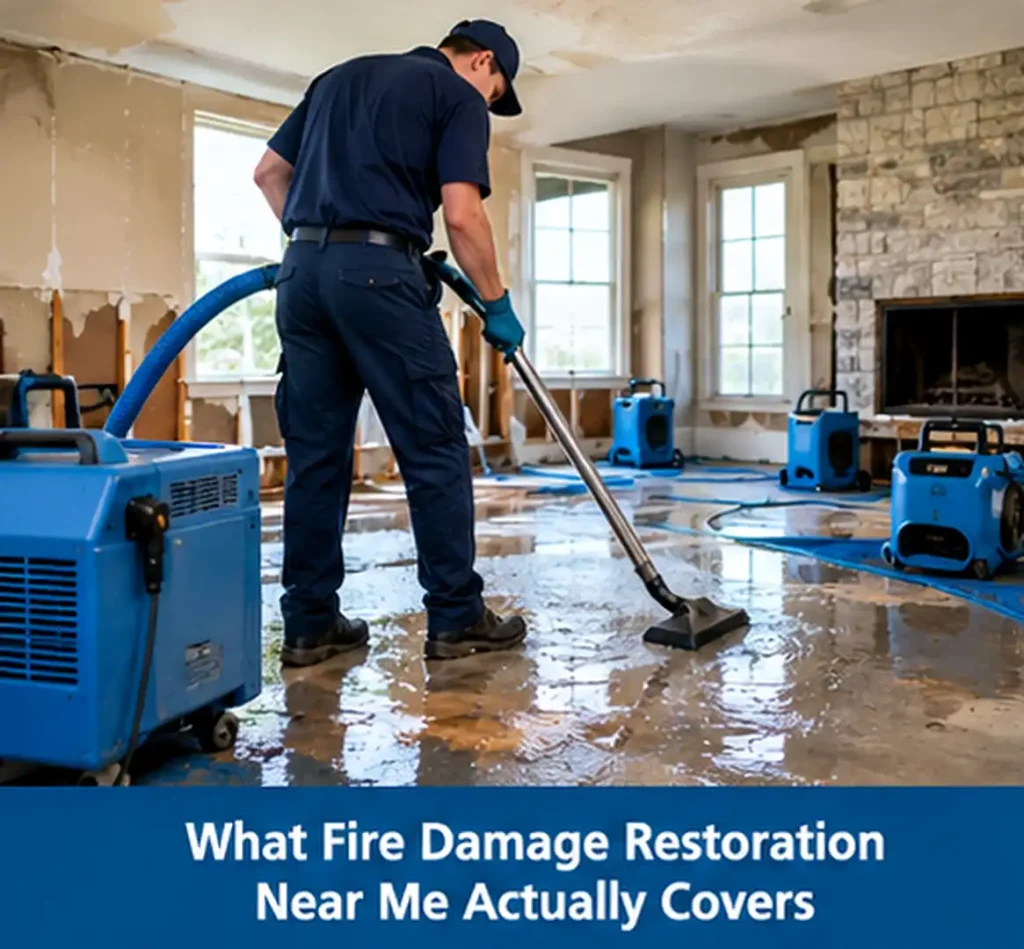
Fire restoration is a four-part recovery process, not just a cleanup. It addresses flame damage, smoke residue, soot contamination, and water damage from firefighting. Most homeowners only see the charred room. Our crews find the expensive damage in the rooms next to it.
On recent emergency calls in Houston and Sugar Land, we traced smoke residue through HVAC returns into bedrooms two rooms away from a kitchen fire. The visible burn zone is often the smallest part of the job.
| Damage Type | What It Does | Hidden Risk | Our Response |
|---|---|---|---|
| Fire / Char | Burns framing, drywall, cabinets, roofing | Weakened load-bearing members | Structural assessment, demolition, rebuild |
| Smoke | Travels through HVAC, wall cavities, attic | Lingering odor, health irritants | HEPA air scrubbing, deodorization |
| Soot | Coats surfaces with acidic carbon residue | Corrosion, permanent staining | Dry sponge, chemical cleaning, sealing |
| Water | Soaks drywall, insulation, subfloor, slab | Mold growth in 24 to 48 hours | Extraction, dehumidification, moisture mapping |
Each damage type needs its own tools and its own standard. The industry benchmark for fire work is the ANSI/IICRC S700 (the Standard for Professional Fire and Smoke Damage Restoration). Water work follows the IICRC S500. A qualified contractor follows both on the same job.
Your next step: walk the home with your contractor and note every room with odor, not just every room with visible burns.
Check Also: Water Damage Restoration McKinney TX: Protect Your Home
Emergency Steps in the First 24 Hours
The first 24 hours decide whether your restoration is a cleanup or a rebuild. Quick action limits soot etching, water migration, and mold growth. It also shows your insurer you took reasonable steps to prevent further damage, which most Texas policies require.
Do These Things First
- Confirm the property is safe. Wait for the fire department to release the structure before you enter.
- Call your insurance carrier. Report the loss and get a claim number the same day.
- Document the damage. Photograph and video every room, ceiling, and closet before anything moves.
- Secure the property. Request emergency board-up for broken windows and roof tarping for ventilation holes.
- Start water removal. Begin extraction of firefighting water within 24 hours.
- Shut off the HVAC system. Running it spreads soot particles into clean rooms.
- Protect undamaged items. Move salvageable valuables to a dry, clean area if it is safe to do so.
Avoid These Common Mistakes
- Do not wipe soot with a wet rag. Water smears it deeper into paint and fabric.
- Do not turn on ceiling fans, lights, or appliances until an electrician clears the wiring.
- Do not eat food exposed to heat, smoke, or firefighting water.
- Do not throw away damaged items before your adjuster sees them.
- Do not use household vacuums on soot. Fine carbon particles pass straight through standard filters.
Most of the permanent damage we see came from well-meaning cleanup done too early. When you call for fire damage restoration near me, ask one question first: “Can your crew start water removal today?” Our 24/7 emergency water removal team handles extraction and board-up on the same visit.
Your next step: save your insurance hotline and a 24/7 restoration number in your phone now, before you ever need them.
How Firefighting Water Creates a Second Disaster
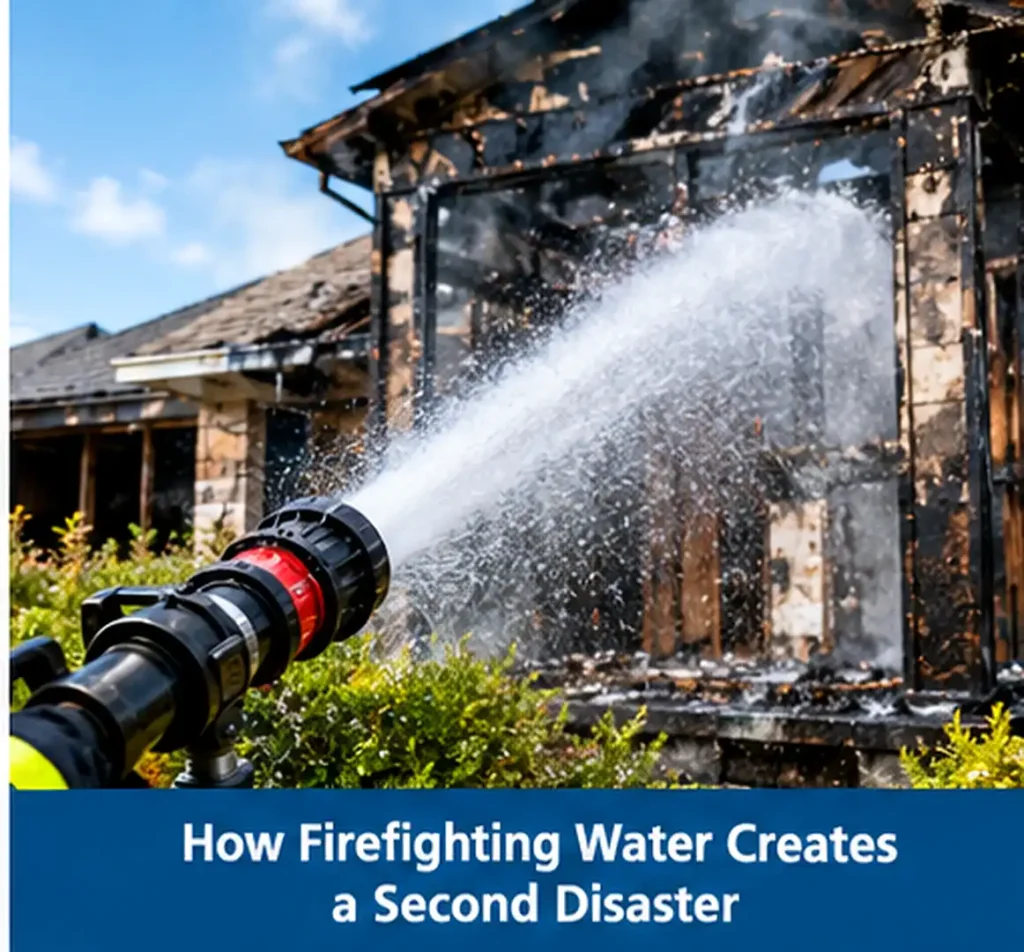
Firefighting water causes as much damage as the fire in many homes. Crews in Pasadena and Pearland often stop a fire in minutes, but they may leave hundreds or thousands of gallons behind. That water carries ash, soot, and chemical residue. We treat it as Category 2 or Category 3 water (gray or black water) under the IICRC S500.
If you have spent a stormy season in Texas, this mitigation strategy makes complete sense. Our field technicians frequently see this in local slab-foundation homes: water wicks into baseboards, travels under laminate, and sits on the concrete. Concrete holds moisture long after the surface looks dry.
According to the EPA’s guidance on mold cleanup, wet materials should be dried within 24 to 48 hours to prevent mold growth. Houston’s average relative humidity often sits above 70%, which makes that window even tighter.
Check Also: Water Damage Restoration Houston TX: Beat the 48-Hour Clock
Firefighting Water Category vs. Cleanup Action
| Water Condition | Category | Cleanup Action |
|---|---|---|
| Clean supply water, no soot contact | Category 1 | Extract, dry, monitor |
| Water mixed with soot and ash | Category 2 | Extract, antimicrobial treatment, remove saturated padding |
| Water sitting 48+ hours or mixed with sewage/debris | Category 3 | Remove porous materials, disinfect, full containment |
Drying Times by Material Type
| Material | Typical Drying Time (with pro equipment) | Salvageable? |
|---|---|---|
| Drywall (lightly wet) | 2 to 4 days | Often yes |
| Drywall (soaked, soot-contaminated) | Not recommended | Usually replaced |
| Carpet pad | Not recommended | Replaced |
| Hardwood flooring | 7 to 21 days | Sometimes |
| Insulation (fiberglass, wet) | Not recommended | Replaced |
| Wood framing | 3 to 7 days | Usually yes |
| Concrete slab | 7 to 30+ days | Yes, with monitoring |
We confirm dryness with moisture meters, thermal imaging, and hygrometers (tools that measure air humidity). We set a dry standard from an unaffected area of the home and do not stop until wet materials match it. That is how you avoid trapped moisture behind new drywall.
Your next step: ask your contractor for daily moisture readings in writing until every material reaches its dry standard.
Smoke and Soot Damage by Surface and Material
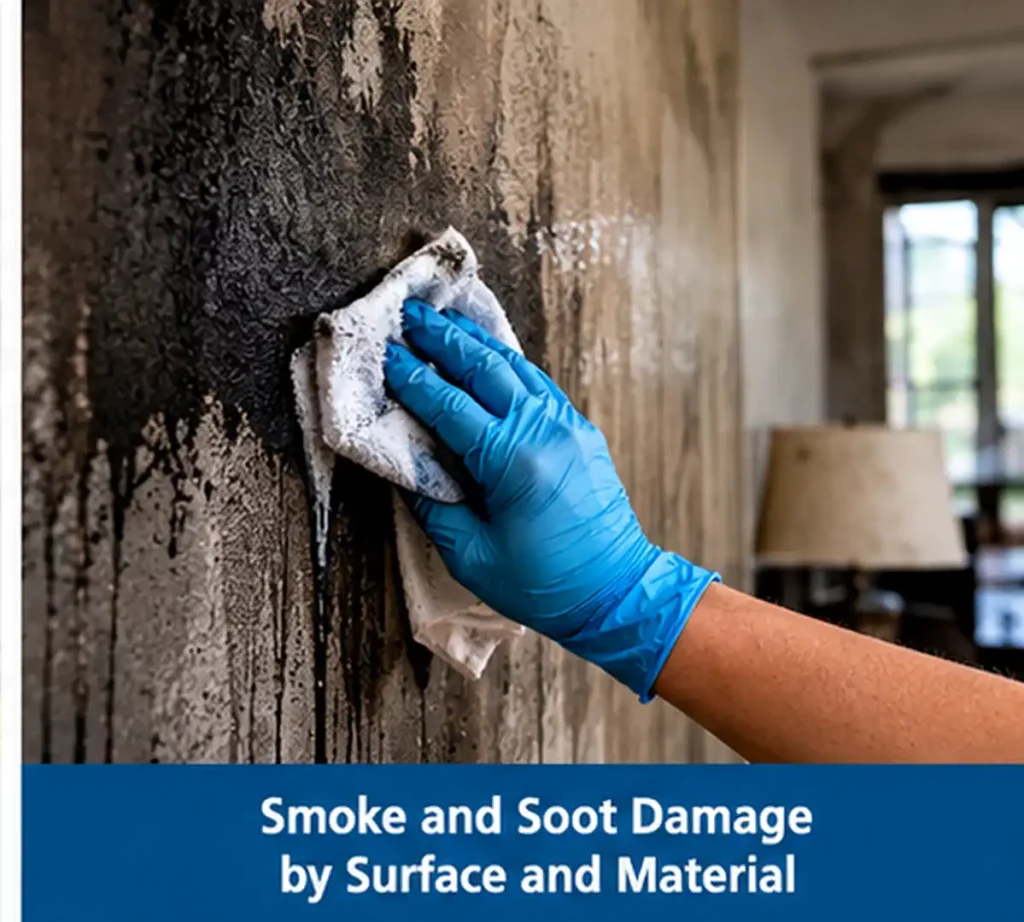
Smoke damage depends on what burned and how hot it burned. A grease fire leaves different residue than a burning sofa. That residue determines the cleaning method, the chemicals, and the labor cost. Identifying the smoke type comes first.
Four Types of Smoke Residue
| Smoke Type | Common Source | Residue Texture | Cleaning Difficulty |
|---|---|---|---|
| Wet smoke | Smoldering plastics, rubber, foam | Sticky, smeary, strong odor | High |
| Dry smoke | Fast, hot fires (paper, wood) | Powdery, dry | Moderate |
| Protein residue | Kitchen fires, burned food | Nearly invisible, yellowish film | High (odor-heavy) |
| Fuel/oil soot | Furnace puff-backs, petroleum | Dense, black, greasy | Very high |
Kitchen fires fool homeowners more than any other type. Protein residue looks clean at first glance. Then the odor comes back on the first humid afternoon.
Soot Cleanup by Surface Type
| Surface | Damage Risk | Cleaning Method |
|---|---|---|
| Painted drywall | Yellowing, staining | Dry chemical sponge, then degreaser; seal with shellac-based primer |
| Unfinished wood | Deep odor absorption | Soda or dry-ice blasting; encapsulating sealer |
| Kitchen cabinets | Protein film, grease | Alkaline cleaner, detail wipe-down |
| Glass and windows | Etching from acidic soot | Prompt cleaning; replace if pitted |
| Metal fixtures | Corrosion, tarnish | Neutralize, clean, polish or replace |
| Upholstery and fabric | Odor, discoloration | Dry cleaning, ozone room, or specialized laundering |
| Carpet | Soot staining, odor | HEPA vacuum, hot water extraction; replace pad |
| Electronics | Internal corrosion | Professional electronics cleaning; do not power on |
How Soot Damage Progresses
| Time Since Fire | What Happens |
|---|---|
| Minutes | Plastics and small appliances discolor |
| Hours | Grout, porcelain, and countertops stain; fiberglass yellows |
| Days | Walls yellow permanently; metal begins to corrode; wood finishes need refinishing |
| Weeks | Carpet and upholstery stain permanently; restoration costs climb sharply |
Your next step: keep your HVAC off and request a smoke-type assessment before any cleaning starts.
Check Also: How Water Damage Restoration Dallas TX Protects Your Home
Odor Removal and Indoor Air Quality
Smoke odor lives in microscopic particles, not just the air. Those particles settle into drywall, insulation, ductwork, and fabric. Air fresheners mask them for a day. Real deodorization breaks them down or removes them.
Our restoration crews notice that odor complaints after a fire usually trace back to one of three places: the attic insulation, the HVAC ducts, or wall cavities near the fire origin. If the source stays, the smell returns.
Odor and Air Quality Equipment
| Equipment | What It Does | Occupied Home Safe? | Best Use |
|---|---|---|---|
| HEPA air scrubber | Captures 99.97% of particles at 0.3 microns | Yes | Soot particles, airborne ash |
| Hydroxyl generator | Uses UV light to create hydroxyl radicals that break down odor molecules | Yes | Ongoing odor removal while people and pets stay |
| Ozone generator | Oxidizes odor molecules with high ozone levels | No, home must be vacated | Severe odor in unoccupied spaces |
| Thermal fogger | Disperses deodorizer that penetrates like smoke | No, during treatment | Wall cavities, attics, porous materials |
| Duct cleaning system | HEPA vacuum and agitation inside ductwork | Yes | Removing soot from HVAC |
| Encapsulating sealer | Locks remaining odor into wood or drywall | Yes, after curing | Framing and subfloor before rebuild |
Odor Removal Process
- Remove the source. Tear out charred materials and soot-saturated insulation.
- Clean every surface. Wash walls, ceilings, and contents to remove residue.
- Filter the air. Run HEPA scrubbers throughout cleaning.
- Neutralize the odor. Apply hydroxyl, ozone, or thermal fogging based on severity.
- Clean the ducts. Treat the HVAC system so it does not redistribute particles.
- Seal affected framing. Encapsulate wood before new drywall goes up.
Moisture and odor problems often overlap. Wet, smoky materials left in place create the perfect setting for fungal growth, which is why our certified mold remediation services often run alongside fire cleanup in humid months.
Your next step: ask whether your contractor plans hydroxyl or ozone treatment, and confirm whether your family needs to leave the home during it.
Structural Assessment and Reconstruction
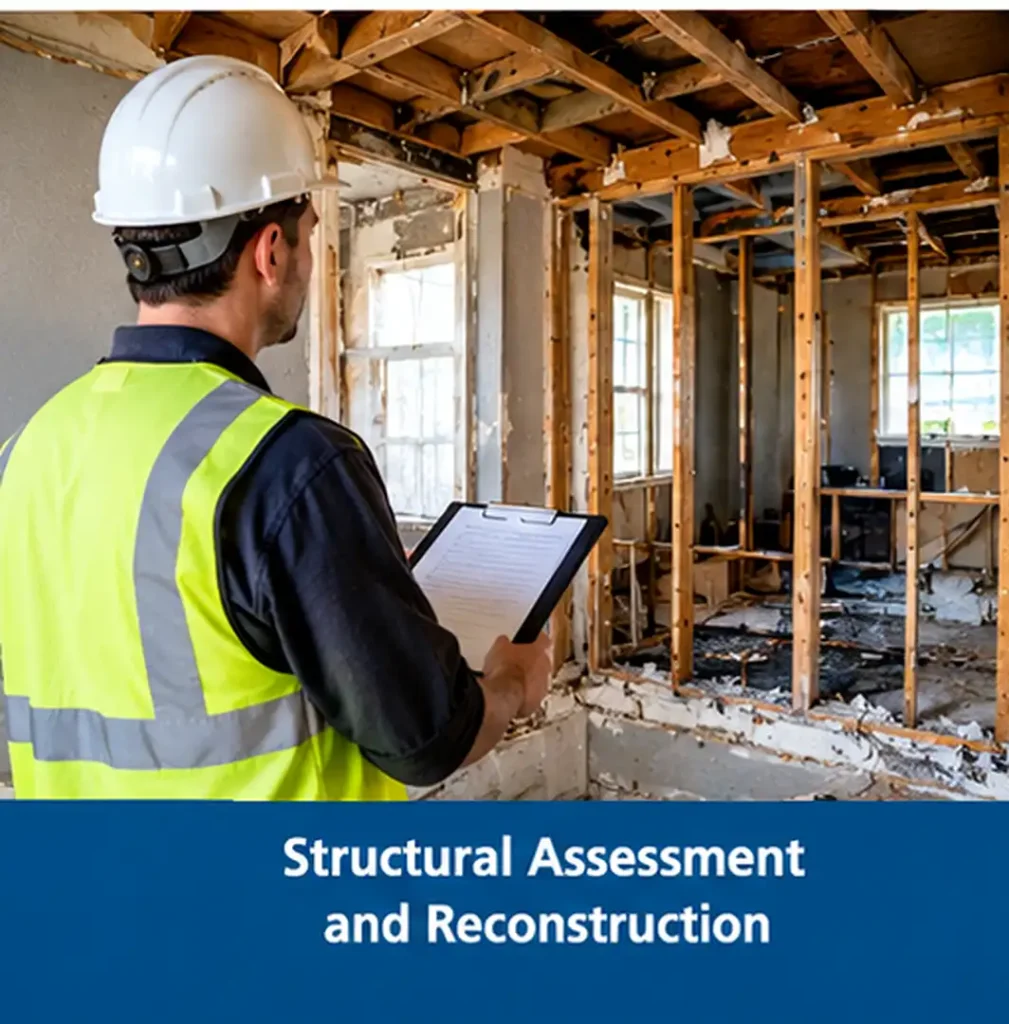
Structural assessment determines what stays and what goes. Heat weakens wood framing, roof trusses, and electrical wiring even when they look intact. Concrete slabs can spall (chip and flake under extreme heat). A trained eye and the right tools catch these issues before rebuild.
What We Inspect
- Roof structure: trusses, decking, and ventilation holes cut by firefighters
- Wall framing: char depth on studs and top plates
- Electrical: melted insulation, damaged breakers, heat-exposed wiring
- Plumbing: heat-stressed PEX or PVC lines that may fail later
- Slab foundation: cracking, spalling, and trapped moisture
- HVAC: soot contamination in air handlers and ducts
Firefighting water and heat can stress a slab at the same time. Our technicians check slab moisture in every Houston-area fire job before new flooring goes down.
The Full Restoration Process
| Phase | Typical Timeline | What Happens |
|---|---|---|
| 1. Emergency response | Day 1 | Board-up, tarping, safety check |
| 2. Assessment | Days 1 to 2 | Damage scope, moisture mapping, photo documentation |
| 3. Water removal | Days 1 to 3 | Extraction, removal of wet porous materials |
| 4. Drying | Days 3 to 10+ | Dehumidifiers, air movers, daily monitoring |
| 5. Soot and smoke cleanup | Days 3 to 14 | Surface cleaning, contents pack-out |
| 6. Deodorization | Days 7 to 21 | Hydroxyl, ozone, fogging, duct cleaning |
| 7. Reconstruction | Weeks 3 to 16+ | Drywall, paint, flooring, cabinets, roofing |
If storms pushed outside water into the home during the same event, our flood damage restoration crews can address both losses under one project plan.
Your next step: request a written scope that separates mitigation (stopping damage) from reconstruction (rebuilding), since insurers often process them separately.
What Fire Restoration Costs in the Houston Area
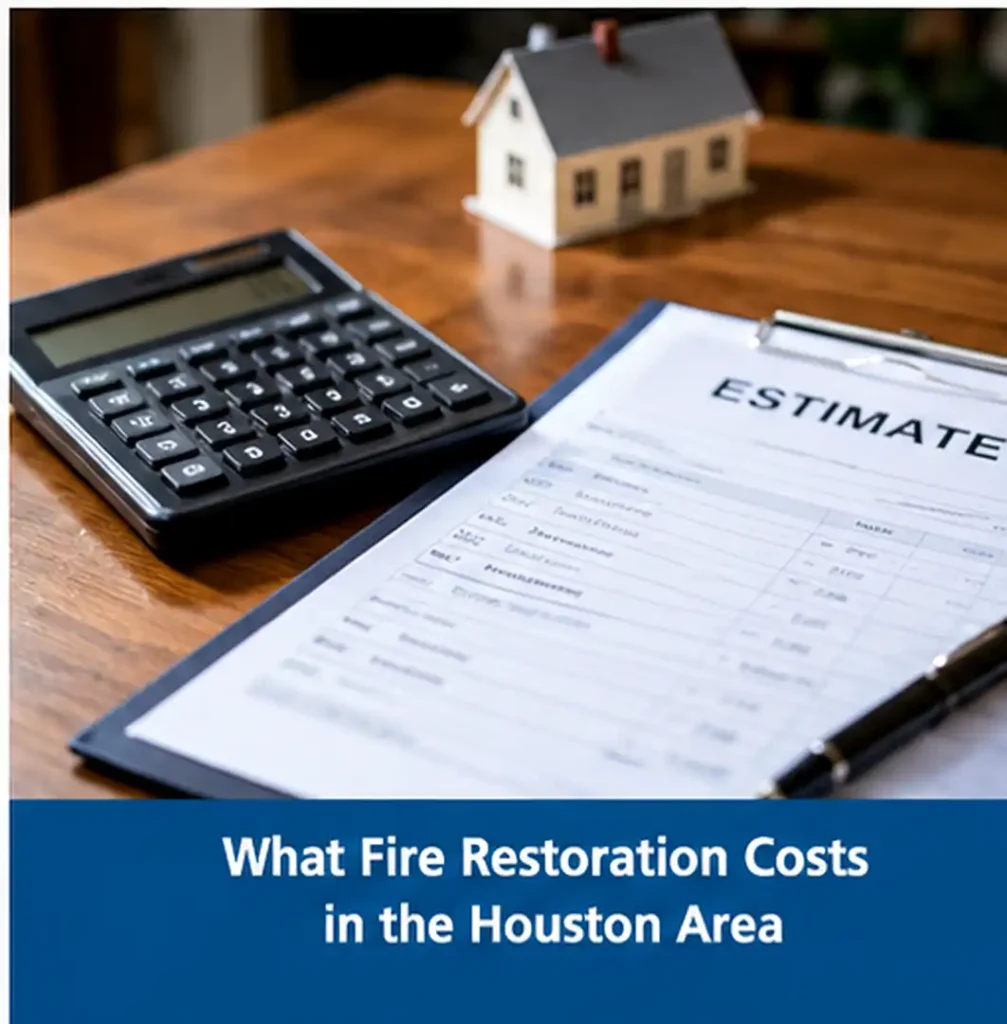
Fire restoration costs depend on square footage, smoke type, and water volume. A small kitchen fire may run a few thousand dollars. A whole-home loss with structural rebuild can pass six figures. The ranges below reflect typical Houston-area pricing in 2026.
| Service | Typical Cost Range | Notes |
|---|---|---|
| Emergency board-up | $300 to $1,500 | Depends on number of openings |
| Roof tarping | $500 to $2,500 | Larger for steep or multi-section roofs |
| Water extraction and drying | $1,500 to $7,500 | Based on water volume and slab saturation |
| Soot and smoke cleaning | $1,000 to $6,000 | Per affected area; wet smoke costs more |
| Odor removal (hydroxyl/ozone/fogging) | $500 to $3,000 | Multi-day treatments add cost |
| HVAC duct cleaning | $500 to $2,000 | Higher if ducts need replacement |
| Contents pack-out and cleaning | $1,500 to $10,000+ | Based on volume of belongings |
| Mold remediation (if needed) | $1,500 to $8,000 | Driven by delayed drying |
| Reconstruction | $100 to $300 per sq ft | Materials, labor, permits |
| Small single-room fire (total) | $3,000 to $15,000 | Typical kitchen or garage fire |
| Whole-home fire (total) | $50,000 to $250,000+ | Includes structural rebuild |
What Drives Your Price Up
- Delayed response: soot etching and mold add new line items
- Wet smoke or protein residue: more labor-intensive cleaning
- Saturated slab: longer drying equipment rental
- Older homes: possible asbestos or lead testing before demolition
Fast mitigation is almost always cheaper than delayed repair. When you compare quotes for fire damage restoration near me, check that each estimate uses the same scope and pricing software, such as Xactimate, which most insurers also use.
Your next step: ask every contractor for an itemized Xactimate estimate so you can compare line by line.
Insurance Claim Guidance for Texas Homeowners

Texas homeowners policies typically cover sudden fire damage, including smoke and firefighting water. Coverage details vary by policy form. The key terms to find in your policy are dwelling coverage, personal property, additional living expenses (ALE), and replacement cost vs. actual cash value (whether you are paid full replacement or a depreciated amount).
Texas Claim Timeline Under the Prompt Payment Law
| Step | Insurer Deadline (Texas Insurance Code Ch. 542) |
|---|---|
| Acknowledge claim and request information | Within 15 days of notice |
| Accept or deny claim | Within 15 business days after receiving all requested items |
| Extension (if insurer needs more time) | Up to 45 additional days, with written notice |
| Pay an accepted claim | Within 5 business days of acceptance |
Deadlines can extend during declared disasters. The Texas Department of Insurance handles complaints if your carrier misses them.
How to Strengthen Your Claim
- Report the loss immediately. Delays can give the insurer grounds to question damage.
- Mitigate further damage. Board-up and water removal are your responsibility under most policies.
- Photograph everything. Capture wide shots and close-ups of each room and item.
- Build a contents inventory. List item, age, purchase price, and replacement cost.
- Save every receipt. Hotel, meals, and storage may qualify under ALE.
- Request the policy in writing. Ask for the full declarations page and endorsements.
- Meet the adjuster with your contractor. A restoration pro can point out hidden smoke and moisture damage.
You have the right to choose your own restoration contractor. Your insurer may suggest a preferred vendor, but you decide who works in your home. A local team offering fire damage restoration near me can work directly with your adjuster on documentation.
For broader disaster prep and recovery steps, FEMA’s Ready.gov home fire guidance covers safety, recovery, and planning for families.
Your next step: download your full policy from your insurer’s app today and highlight the ALE and replacement cost sections.
Fire Restoration Across Houston, Pasadena, Pearland, Sugar Land, and League City
Local conditions shape every fire job. Gulf Coast humidity, slab foundations, and storm season all affect how fast damage spreads. A homeowner searching fire damage restoration near me in League City faces different drying challenges than one in a dry West Texas town.
| Area | Common Fire Sources We See | Local Restoration Challenge |
|---|---|---|
| Houston | Kitchen fires, electrical faults in older homes | High humidity speeds mold after firefighting |
| Pasadena | Garage and workshop fires | Fuel and oil soot residue |
| Pearland | Dryer vent and appliance fires | Smoke spread through newer open floor plans |
| Sugar Land | Kitchen fires, holiday decoration fires | Protein residue odor in large homes |
| League City | Electrical fires after storm surges | Combined storm water and fire damage |
On recent emergency calls in Pearland and Sugar Land, we found that open-concept layouts let smoke travel faster than older, compartmented homes. More open space means more surfaces to clean. We adjust air scrubber placement and containment for each layout.
Your next step: note your home’s foundation type and HVAC age, since both affect your restoration plan.
How to Choose a Fire Restoration Company Near You
The right contractor handles fire, smoke, and water under one roof. Splitting the job across multiple companies creates gaps in moisture monitoring and documentation. Look for IICRC certification, 24/7 response, and insurance billing experience.
Contractor Checklist
- IICRC-certified technicians in Fire and Smoke Restoration (FSRT) and Water Restoration (WRT)
- 24/7 emergency response with arrival times under 2 hours
- Licensed, bonded, and insured for Texas
- Direct insurance billing and Xactimate estimates
- Moisture mapping and daily drying logs
- In-house mitigation and reconstruction
- Local references in your city
DIY Cleanup vs. Professional Restoration
| Factor | DIY Cleanup | Professional Restoration |
|---|---|---|
| Cost upfront | Lower | Higher, often covered by insurance |
| Soot removal | Risk of smearing and staining | Dry sponges, HEPA vacuums, chemical cleaners |
| Odor removal | Masks smell temporarily | Hydroxyl, ozone, thermal fogging |
| Water drying | Fans miss hidden moisture | Moisture meters, commercial dehumidifiers |
| Insurance documentation | Often incomplete | Itemized, adjuster-ready reports |
| Health risk | Exposure to soot particles | Proper PPE and containment |
Choosing fire damage restoration near me from a company that also specializes in water work matters in Texas. Firefighting water and humidity are often the bigger long-term threat. You can reach our 24/7 restoration response team any time for an on-site assessment.
Your next step: call two certified companies, ask for their arrival time and certifications, and compare answers in writing.
FAQs
How soon should fire restoration start?
Within 24 hours. Soot damage and mold risk increase every hour that water and residue stay in place.
How long does fire damage restoration near me usually take?
Small fires take 1 to 3 weeks. Whole-home fires with reconstruction take 3 to 6 months or longer.
Is firefighting water covered by homeowners insurance?
Yes, in most Texas policies. Water damage caused by putting out a covered fire is usually part of the fire claim.
Can I stay in my home during restoration?
It depends on damage level. Homes with heavy soot, ozone treatment, or no working utilities are not safe to occupy.
Will the smoke smell ever go away?
Yes, with source removal, cleaning, deodorization, and sealing. Air fresheners alone will not solve it.
Can soot-damaged clothes be saved?
Most can. Specialized laundering and ozone treatment restore many fabrics if cleaned within days.
Do I need mold testing after a fire?
If materials stayed wet more than 48 hours, yes. Houston humidity makes this a common follow-up step.
Can I pick my own restoration company?
Yes. Texas homeowners have the right to choose their contractor, even if the insurer recommends one.
Is it safe to run my AC after a fire?
Not until the HVAC system is inspected and cleaned. Running it spreads soot through the whole home.
Your Next Step After a Fire
Fire recovery depends on speed, documentation, and moisture control. Soot gets worse by the hour. Firefighting water sets up mold within two days. Insurance claims go smoother with clear photos and an itemized scope.
At Bob’s Water Damage Restoration, we handle extraction, drying, smoke cleanup, and odor removal across Houston, Pasadena, Pearland, Sugar Land, and League City.
When you search for fire damage restoration near me, choose a crew that treats the water as seriously as the fire. Call our 24/7 line today to schedule an on-site moisture and smoke assessment.